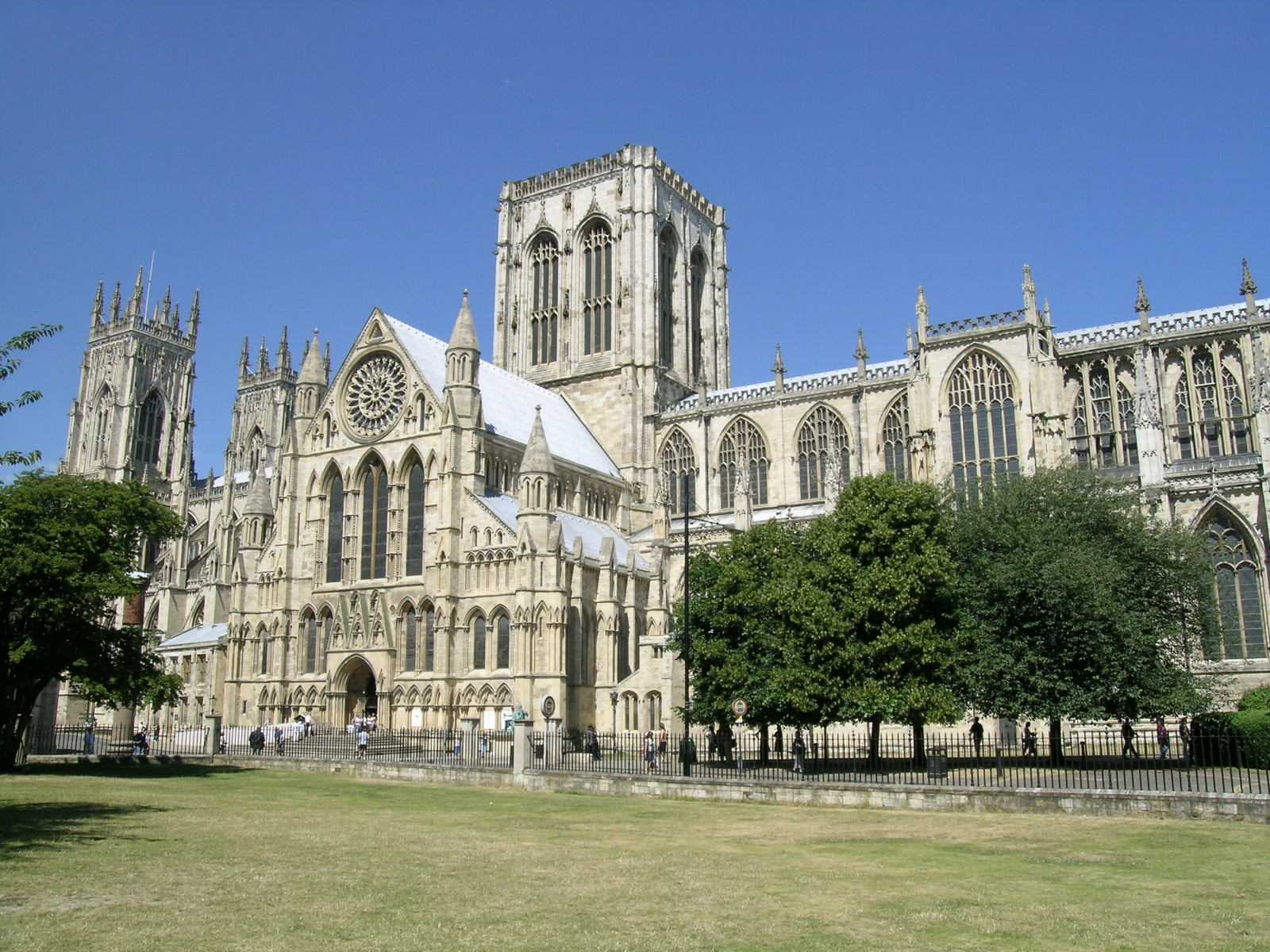
York Minster Gothic Cathedral in YorkSituated in the heart of the city, York Minster is the largest Gothic Cathedral in northern Europe. It was built in the shape of a cross, and
faces East, towards Jerusalem. The name "Minster" is derived from the Latin
Monastarium, which means "Place of Learning". The first building to grace the site on which the present Minster now stands were the military headquarters during Roman occupation, known during those times as Principia. Constantine the Great was proclaimed as Emperor in 306AD, close to where his bronze statue stands outside the South Transept. He introduced Christianity to the Roman Empire and was baptised on his deathbed in 337.
Before the Minster the first church here was a wooden structure, built in 627 for the baptism of the King Edwin of Northumbria, following his marriage to a Christian. This
was replaced after his death by a stone Minster, in 633, and was dedicated
to St Peter. St Peter was a disciple of Christ and was entrusted with the
job of keeper of the keys (to heaven). This is why the Cross Keys are very
often to be seen incorporated into decorative work around the City and in
the Minster.
At least two more stone buildings went before the present Minster, first
commissioned in 1220 and finished in 1472.
The stained glass windows of the Minster are huge, it would be a good idea
to take binoculars if you want to see the finer detail, the stonework and
tracery; and to examine the historical events and biblical stories contained
and preserved in this building for hundreds of years. If you are visiting
with children a pen and notepad might also help to make it more interesting
for them, as explained shortly!
 |
 |
As you enter the building through the door of the South Transept you will be
facing the North Transept, the East end is to your right, the West to your
left. A ramp is now in place outside for wheelchair access, so most of the
Minster is available to all. As you go in you will be given a map to help
you find your way around.
The East End of the Minster consists of the raised area in the middle which
is the Choir and High Altar. It is surrounded by the South Choir aisle, Lady
Chapel and the North Choir aisle; and fronted by the Choir Screen. The Choir
Screen was built in the 15th century to strengthen the east wall of the
central tower and is decorated with statues of fifteen Kings of England, the
first being William 1 (The Conqueror), to Henry V11. The heavenly choir of
Angels above them were added much later, in the early 19th century.
If you begin your walk in the North Choir aisle you will see a collection of
panels worked by the Broderers Guild depicting all the animals and birds
that can be found in the Minster. They could be in the windows, in stone
carvings or decorating the tombs. The younger visitors might enjoy noting
them to see how many they can find. To start them off, two designs can be
seen on the front base of one of the tombs a little further down that aisle,
a dog and a cockerel. As you walk along these aisles you can also see under
the Choir and Altar into the undercroft. |
The largest of the windows is the Great East Window, situated behind the
High Altar and the Choir, in the Lady chapel. The size of a tennis court, it
is the largest stained glass window in the world. It contains 117 panels in
rows of nine and depicts the beginning and end of the world.
Beneath it much of the original woodwork in the east end of the Minster was
destroyed during the fire of 1829, started by religious fanatic Jonathan
Martin, and has been replaced by Victorian work. The stalls in the Lady
Chapel were the work of Robert 'Mousey' Thompson, a local carpenter who
declared that he had been 'As poor as a church mouse' early in his career,
and carved a mouse into his work as a trademark. Look closely!
Also in this part of the Minster, at the High Altar to the south of the
Choir, is the canopied 'Cathedra'. Latin for seat, or throne, it is the
throne for the Archbishop of York. From this we are entitled to call the
Minster a Cathedral.
The North and South Transepts are separated by the Lantern Tower where you
can look up, or use the mirror, to see the incredible workmanship of the
interior of the central tower.
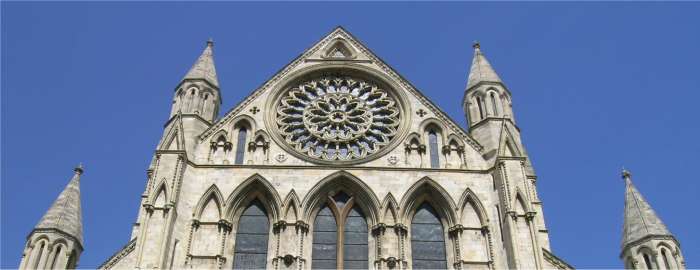
The South Transept is home to the Rose window, the circular window above the
South Door. The centre of this window depicts a sunflower, surrounded by 24
panels containing alternate red and white roses. This signifies the end of
the 'War of the Roses' with the marriage of Elizabeth of York to the
Lancastrian King Henry V11 in 1486. This transept was badly damaged in the
fire of 1984, the cause being a lightening strike. The fire destroyed the
roof of the transept, but fortunately the Rose window could be carefully
restored and strengthened. The roof and vaulting had to be replaced, within
the bosses of the new roof are six designs by children who won a competition
run by the BBC's Blue Peter programme.
Here are the entrances to the undercroft, and the steps up to the tower. The
top of the central tower is open to the public and gives a magnificent view
of York, for miles on a clear day. Unfortunately it is not advisable for
anyone who is claustrophobic or unfit to tackle the 279 spiral steps to get
there. Alternatively you can go down to the undercroft to see the supports
of the central tower and Roman remains, Norman remains and many artefacts
relating to periods pre-dating the present Cathedral.
The North Transept is dominated by the Five Sisters window, together the
five slender lancet windows form the largest lancet window in the world, it
dates at c.1260 when the Transept was built. It is filled with Grisaille
glass, a French term used to describe the Grey/silver colour, and is
decorated with leaves of the Geum plant which was a plant often used in the
middle ages as it was believed to have healing qualities. The window
features in the Charles Dickens novel 'Nicholas Nickleby' and there are a
few translations of the story about a vision of five sisters sewing being
the origin of the name for this window. It became the memorial to the women
of the Great war who lost their lives, and later to the women who died in
the second World war.
 |
Also in the North Transept is the Hindley Clock, made by a local clockmaker
in 1749. The two oak carved figures, called 'quarter jacks' (because they
strike the quarter hour), are called Gog and Magog and are estimated to be
more than 400 years old.
The West End is divided into a south and north aisle with the Nave in the
middle. The West Window is also known as the Heart of Yorkshire because the
tracery in the upper part of the window forms the shape of a heart. Worth
seeing in the west wing, especially for those who have been searching for
animals, is the monkeys funeral. Situated in the North aisle, three windows
back from the North Transept, it is formally known as the Pilgrimage window.
Bottom left in the border can be seen the procession of monkeys carrying a
coffin, also in the border is a fox stealing a chicken, a dog chasing a
stag, a cockerel reading a lesson and various other animals.
I have only scrapped the surface of the history and contents of the Minster
of York, but I hope I have given you enough of interest to get you started!
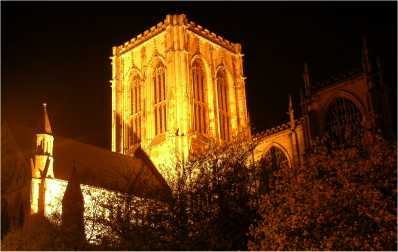
York Minster is a joy to see, inside and out, in summer with the sun on the
windows, or illuminated on a winters evening.
History of the site before the Minster was built
More information on York Minster
|